Number 1 of "Ten things I love about Japan".
One has to begin here. Where else?
I can remember thinking, as a teenager in the eighties, how bizarre all of this raw-fish-and-seafood-eating was, and how exotic. Now having lived in Japan, it seems at once the most ordinary and the most indispensable thing. This is not to say that I routinely eat sushi or sashimi in Australia: I do have some standards. But then, I spend part of any given year in Japan, so I can afford to have standards.
Let's briefly get the terminology straight: sushi actually refers to the vinegared rice that is the base of the dish. Raw fish is only the most common of the toppings. Vegetables, seafood, cooked fish, cooked eel, and various other toppings are also used. And sashimi refers not only to slices of raw fish, but slices of raw flesh of any kind: chicken sashimi is extraordinary, although (I must stress) it's something I will only eat in Japan, in certain very good restaurants, in the company of culturally competent people whom I trust.
My typical sushi session begins with tamago (egg; in this case sweetened and scrambled) on sushi rice: even in Japan my habits are conservative. Then one of the mackerels: saba or sawara or aji or sanma. Then in no particular order a selection of hamachi (yellowtail) or kanpachi (a younger version), maguro (bluefin tuna), katsuo, iwashi (sardine), ebi (shrimp), and ika (squid). I go light on the last two, on account of my cholestorol, saving my ration for hotate (scallop), my preferred sushi-dessert. I'll toss in cooked unagi (freshwater eel) if I am in the mood. Soy as a dipping sauce, but not for unagi, which has its own special topping-sauce (similar to worcestershire), or for katsuo. The whole thing is helped along its way by pickled ginger as a palate-cleanser between sushi dishes, and generous quantities of green tea. Between these and the wasabi swiped onto the sushi rice, just underneath the topping, a sushi dinner doubles as an excellent herbal remedy against a cold ...
I am especially partial to katsuo. Wikipedia tells me that it's called skipjack tuna or bonito in English, and it may well be: but they mention nothing of its very particular, strong-but-not-overwhelming taste, or its texture. Texture is as much a feature of sushi and sashimi as taste, although I have no good vocabulary to describe it.
If you want to drink sake (rice wine) with the meal --- and I often do --- it's a better complement to sashimi. Sashimi can be served as an element of a multi-dish meal, or as a meal on its own: in both cases it comes garnished with shredded daikon, a white asian radish. When eating sashimi one has to add one's own wasabi --- not too much, people: it is not a contest! --- and if one adds it to the soy, there's the problem of keeping the daikon from soaking it all up: there seems to be some evil wasabi-daikon affinity. But I digress. My tastes in sashimi are similar to my tastes in sushi toppings, but with the addition of salmon (salmon sushi exists, but I am not a fan), and raw shrimp (likewise). And as for katsuo: you can get great huge inexpensive trays of the stuff at supermarkets --- its own special sauce included --- sometimes of a particular kind that's blackened just on the very outside layer, and still raw inside. I've no idea why it's so cheap.
If you do get trays of take-out sashimi from supermarkets, as I did a lot, you can wait until after local Japanese dinner-hour and get it at half-price: perfectly timed for the foreign researcher, cycling home from the lab. The quality is not as good as at a restaurant, but pretty good nonetheless: very good, by Australian standards. The same goes for sushi. As a take-out lunch, or for a dinner to take to duty-shift (eight hours staring at computer terminals underground: one gets hungry), I would often get a maguro plate: various tuna cuts including toro (more fatty), and various sushi types, like maki sushi (little rolls of sushi rice with nori [seaweed] wrapped around the rim, and a fish or vegetable core), and something similar but with the nori wrapping solid sushi rice, with minced raw fish on the top (I don't know the name). Trays with a full sushi selection are also sold; or trays of maki sushi, or some other type. One can also get inari sushi --- sushi rice stuffed into fried brown tofu --- although it's not my thing.
But the real deal is a restaurant meal: in my case (more by laziness than by other reason) it was often at conveyor sushi. It is a macho thing to be a sushi chef, and food-preparation-as-performance-art, still a relatively exotic thing for us Westerners, is part of the experience at a good kaiten-zushi house. Conveyor sushi is typically Japanese brilliance, by the way: fast food for the civilised.
Sunday, 23 December 2007

Ten things I love about Japan
Number 0: prolegomenon
I was based in Japan for six years, which is too long for somewhere you're just not that into (as the saying goes). And like all resident gaijin, I've spent far too much time sitting around and griping about the place. If you've known any resident gaijin, you will know what I mean.
So it's time for a new approach. I am going to write ten posts on things I love about Japan, starting today in honour of the emperor's birthday. They will not all be about food --- although quite a few will be --- and if you've heard me talk about my time there I suppose you'll be able to guess some of my favourite things. But I hope there will be one or two surprises ...
I was based in Japan for six years, which is too long for somewhere you're just not that into (as the saying goes). And like all resident gaijin, I've spent far too much time sitting around and griping about the place. If you've known any resident gaijin, you will know what I mean.
So it's time for a new approach. I am going to write ten posts on things I love about Japan, starting today in honour of the emperor's birthday. They will not all be about food --- although quite a few will be --- and if you've heard me talk about my time there I suppose you'll be able to guess some of my favourite things. But I hope there will be one or two surprises ...
The Clinton legacy
The Democratic primary contest for the upcoming US election is remarkable in that former two-term president William Jefferson Clinton --- can't you just tell, from their names, that Americans take themselves more seriously than Australians do? --- is a leading campaigner ... on behalf of his wife, Hillary Rodham Clinton.
There is an excellent article in this weekend's magazine section of the New York Times, The Clinton Referendum, discussing the extent to which Mrs Clinton's campaign is turning into a referendum on her husband's legacy: this then opens up into a discussion of that legacy itself.
It is interesting to reflect on the similarities, and the differences, to the situation in Australia, where there has been a long-overdue renewal of Labor Party government. I have missed the Hawke/Keating administration with a passion for all of the last eleven-and-a-half years, and it is true that Kevin Rudd is neither Bob Hawke nor Paul Keating ... but then, for all that he stands on their shoulders, it's good that he isn't either of these men. Theirs were not flawless governments. I am glad to see that we are moving on from them, in a way (I must hope) that acknowledges and builds on their strengths. Maybe the way to do this, in the American case, is with a president who is not also a Clinton?
There is an excellent article in this weekend's magazine section of the New York Times, The Clinton Referendum, discussing the extent to which Mrs Clinton's campaign is turning into a referendum on her husband's legacy: this then opens up into a discussion of that legacy itself.
It is interesting to reflect on the similarities, and the differences, to the situation in Australia, where there has been a long-overdue renewal of Labor Party government. I have missed the Hawke/Keating administration with a passion for all of the last eleven-and-a-half years, and it is true that Kevin Rudd is neither Bob Hawke nor Paul Keating ... but then, for all that he stands on their shoulders, it's good that he isn't either of these men. Theirs were not flawless governments. I am glad to see that we are moving on from them, in a way (I must hope) that acknowledges and builds on their strengths. Maybe the way to do this, in the American case, is with a president who is not also a Clinton?
Thursday, 20 December 2007
If the facts do not conform to the theory ...
... what do you do?
Over the last five years or so there has been a test case for this in particle physics, where experimental results and the expectation from theory were completely at odds: qualitatively different, and (where they could be compared numerically) out by a factor of ten or more.
My review of the experimental situation, Double ccbar production in e+e- annihilations at high energy, is now available on the web as arXiv:0712.3138 [hep-ex]. If you want the short version: theory fought experiment, and experiment won. In principle this always happens, but the trick is to get it to work out in practice. And the short version is of course prejudicial: it was always possible that something had been neglected in the analysis (there were some ingenious suggestions), or that some mistake had been made. The rhetoric about a theory being thrown out the moment you see a piece of contrary data sounds unlikely --- or just plain wrong --- and indeed it is. If you want to get a feel for how this sort of thing really plays out, at least in my field, read on. I can't claim that it'll be accessible unless you have some particle physics, however.
(This paper is the long-overdue writeup of a review I presented at the International Workshop on Charm Physics, a meeting I helped organise at Cornell in August. I posted earlier concerning the future of charm physics, the panel discussion that closed the workshop.)
Over the last five years or so there has been a test case for this in particle physics, where experimental results and the expectation from theory were completely at odds: qualitatively different, and (where they could be compared numerically) out by a factor of ten or more.
My review of the experimental situation, Double ccbar production in e+e- annihilations at high energy, is now available on the web as arXiv:0712.3138 [hep-ex]. If you want the short version: theory fought experiment, and experiment won. In principle this always happens, but the trick is to get it to work out in practice. And the short version is of course prejudicial: it was always possible that something had been neglected in the analysis (there were some ingenious suggestions), or that some mistake had been made. The rhetoric about a theory being thrown out the moment you see a piece of contrary data sounds unlikely --- or just plain wrong --- and indeed it is. If you want to get a feel for how this sort of thing really plays out, at least in my field, read on. I can't claim that it'll be accessible unless you have some particle physics, however.
(This paper is the long-overdue writeup of a review I presented at the International Workshop on Charm Physics, a meeting I helped organise at Cornell in August. I posted earlier concerning the future of charm physics, the panel discussion that closed the workshop.)
Sunday, 16 December 2007
Tambourines and elephants
My research group had colleagues visiting from interstate last week, and after our official dinner some of us went out to karaoke in town. Some inspired person proposed Lookin' Out My Backdoor for what turned out to be the final song of the evening. Ever since, Creedence Clearwater Revival has been on high rotation in my CD deck, and in my head.
There is such joy in some of these CCR songs: unabashed, unashamed, unironic delight. There's some safety in it at karaoke --- one can always add inverted commas according to taste --- but I prefer to take it straight.
Look at all the happy creatures dancing on the lawn ...
There is such joy in some of these CCR songs: unabashed, unashamed, unironic delight. There's some safety in it at karaoke --- one can always add inverted commas according to taste --- but I prefer to take it straight.
Look at all the happy creatures dancing on the lawn ...
Wednesday, 12 December 2007
Truthful myths
A thoughtful Herald today! Here are fighting words from John Gray, self-proclaimed sceptic:
While the myths of religion express enduring human realities, the myths of secular humanism serve only to conceal them. It may be a dim sense of the unreality of their beliefs makes militant atheists so vehement and dogmatic.As a scientist who is also a relatively conservative Christian, I have been dismayed by the recent descent into Philistine belligerence in the ongoing Science-Religion turf war. Here's a hint, people: if you can look at the capital letters on "Science" and "Religion" in the preceding sentence, and not feel an immediate need to swathe them in inverted commas, you are probably part of the problem.
One searches in vain in the company of militant unbelievers for signs of the creative doubt that has energised many religious thinkers...
Tanya on Jane on Catherine and reading and ...
In today's Herald, my near-contemporary Tanya Plibersek, Federal member for Sydney and recently-appointed minister for something-or-other, makes a heartfelt plea for reading, fiction in general, and Jane Austen in particular. I like her better already.
Sunday, 9 December 2007
Life imitating art (imitating life)
The previous post reminds me --- fans will understand --- of Kiefer Sutherland's impending stint in jail for a repeat drink-driving offence. Quite a serious offence, it seems, from the description.
A lot of the credibility of the Jack Bauer character in 24 comes from the sense of damage about him: the feeling that the haunted look, and the troubled backstory, are not just window-dressing. Mr Sutherland's rather public excesses and disappointments --- and the plain fact that he struggles with them, not always successfully --- are thus one of the key things he brings to the role. As well, of course, as physical believability (if one can call anything in 24 believable), acting ability, and that wonderful, wonderful voice. Someone described it as velvet, wrapped around a brick. It's as like, and as unlike his father's, as the two are like and unlike each other, but it's when Kiefer is playing Jack calm, and the innate courtliness and respectfulness of the man comes out, and yet he still has to be menacing, that one says "Yes, he is his father's son".
A lot of the credibility of the Jack Bauer character in 24 comes from the sense of damage about him: the feeling that the haunted look, and the troubled backstory, are not just window-dressing. Mr Sutherland's rather public excesses and disappointments --- and the plain fact that he struggles with them, not always successfully --- are thus one of the key things he brings to the role. As well, of course, as physical believability (if one can call anything in 24 believable), acting ability, and that wonderful, wonderful voice. Someone described it as velvet, wrapped around a brick. It's as like, and as unlike his father's, as the two are like and unlike each other, but it's when Kiefer is playing Jack calm, and the innate courtliness and respectfulness of the man comes out, and yet he still has to be menacing, that one says "Yes, he is his father's son".
Friday, 7 December 2007
Atonement, gentlemen!
I have been numbering the days to the Australian release of Atonement, Joe Wright's adaption of the extraordinary Ian McEwan novel. I love McEwan, I enjoyed the novel, and I was very impressed (despite my prejudices) with Wright's adaption of Pride and Prejudice, and with Keira Knightley as Lizzy. So after reading rave UK reviews of the new film back in September, I started counting down to Boxing Day.
But then I read A.O. Scott's review in today's New York Times. To quote it in part:
Of course, I'm still going to see it. Two hours spent watching Keira Knightley and Vanessa Redgrave can never be entirely wasted; and they say that Saoirse Ronan, the newcomer playing the young Briony, is superb. But even so I have to hope that A.O. Scott is mistaken: and that doesn't happen often.
But then I read A.O. Scott's review in today's New York Times. To quote it in part:
This is not a bad literary adaptation; it is too handsomely shot and Britishly acted to warrant such strong condemnation. “Atonement” is, instead, an almost classical example of how pointless, how diminishing, the transmutation of literature into film can be. The respect that Mr. Wright and Mr. Hampton show to Mr. McEwan is no doubt gratifying to him, but it is fatal to their own project.My anticipation of the film is now taking on a different colour. Ominously, the novelist remarked that "The one thing movies don’t do particularly well is consciousness, and the book is largely about consciousness. But I think [the filmmakers] got around it pretty well." I took that one way when I first read it; now knowing Scott's reaction to the film, it's adding to my unease.
Of course, I'm still going to see it. Two hours spent watching Keira Knightley and Vanessa Redgrave can never be entirely wasted; and they say that Saoirse Ronan, the newcomer playing the young Briony, is superb. But even so I have to hope that A.O. Scott is mistaken: and that doesn't happen often.
Sunday, 18 November 2007
Miserere mei, Deus
Recently I've been listening again to Arvo Pärt's setting of the Miserere: Psalm 51 in the Hebrew (and usual English) order. Pärt's music sustained my devotional life --- such as it is --- through many expatriate years, and this setting of the great Biblical text is my personal favourite, and surely one of the best among Pärt's compositions.
It takes a little patience to approach it. An open copy of the Latin text will help, unless you know the psalm well enough in English (and have enough bluffer's Latin) to wing it as the song proceeds. The first three verses are quiet and reflective, almost to the point of stillness, until at peccatum meum contra me est semper (3b: "my sin is ever before me"), the setting falls endlessly into a great pit of music: the Dies Irae, no less.
Nine minutes in, one finds that all of this has been a preliminary. Stillness and quiet return, and the psalm begins a long slow climb of complexity, volume, and spirit, building to a sustained climax from verses 13-17: its two great peaks at Docebo iníquos vias tuas (13a: "Then I will teach transgressors your ways"), and holocaustis non delectaberis (16b: "You are not pleased with burnt offering") will take your breath away. And then verse 17's reflection, that the sacrifice [acceptable to] God is a broken spirit, appears as a still small voice after the storm.
This is a clever, sensitive, faithful reading of the psalm, and revelatory if you've been brought up (as I was) on sentimental and popular treatments that focus on verses 10-12. Let the reader understand: music, and specifically a demanding musical setting, can teach. This is how it's done.
An acquaintance was recently taking a shot at that most stationary of targets, the current state of Christian music. ("How the mighty have fallen" pretty much sums it up.) And it's true that there is very little to say in its defence. But I will defend Pärt anywhere, and in any company.
It takes a little patience to approach it. An open copy of the Latin text will help, unless you know the psalm well enough in English (and have enough bluffer's Latin) to wing it as the song proceeds. The first three verses are quiet and reflective, almost to the point of stillness, until at peccatum meum contra me est semper (3b: "my sin is ever before me"), the setting falls endlessly into a great pit of music: the Dies Irae, no less.
Nine minutes in, one finds that all of this has been a preliminary. Stillness and quiet return, and the psalm begins a long slow climb of complexity, volume, and spirit, building to a sustained climax from verses 13-17: its two great peaks at Docebo iníquos vias tuas (13a: "Then I will teach transgressors your ways"), and holocaustis non delectaberis (16b: "You are not pleased with burnt offering") will take your breath away. And then verse 17's reflection, that the sacrifice [acceptable to] God is a broken spirit, appears as a still small voice after the storm.
This is a clever, sensitive, faithful reading of the psalm, and revelatory if you've been brought up (as I was) on sentimental and popular treatments that focus on verses 10-12. Let the reader understand: music, and specifically a demanding musical setting, can teach. This is how it's done.
An acquaintance was recently taking a shot at that most stationary of targets, the current state of Christian music. ("How the mighty have fallen" pretty much sums it up.) And it's true that there is very little to say in its defence. But I will defend Pärt anywhere, and in any company.
xkcd
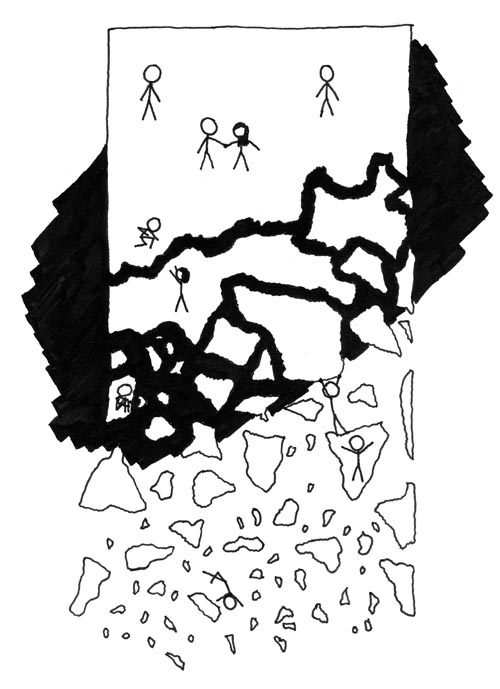
Recently I've been enjoying xkcd, aptly described on its site as "A webcomic of romance, sarcasm, math, and language." This example is "Fall Apart", from 5th May last year.
It's not for everyone, by any means, but if you've ever been a geek, or loved one, you'll find something here to like. Spoiler Alert is one of the more accessible examples of the strip's sense of humour. (Note: it means what it says.)
Thursday, 15 November 2007
The future of charm physics
It was my privilege, back in August, to chair the panel discussion that closed the International Workshop on Charm Physics at Cornell University.
My writeup for the conference proceedings, The future of charm physics: a discussion, is available on the web as arXiv:0711.1636 [hep-ex].
My writeup for the conference proceedings, The future of charm physics: a discussion, is available on the web as arXiv:0711.1636 [hep-ex].
Subscribe to:
Posts (Atom)