Much as I enjoy xkcd like any other nerd, I sometimes find Randall Munroe's sense of humour grating: self-satisfied, snarky, and (especially in sexual matters) boastful and oversharing. (This latest part may well be pure wish-fulfilment on his part: I'm ignorant of his real-world life.)
But just to keep me on my toes, here is his tribute to Fred Rogers, a mainstay of American children's television, of whom I was previously ignorant. It is hard to imagine someone with a more different sensibility.
The NYT's 2003 obituary for Fred Rogers offers more information.
Showing posts with label comics. Show all posts
Showing posts with label comics. Show all posts
Tuesday, 20 July 2010

Sunday, 24 January 2010
Someone old, nothing new, someone French, someone blue; someone radiant, some history, and a good point
Some things I noticed recently:
One gets a much more measured treatment of the ongoing disaster in Haiti from the NYT than one does from the TV news in Sydney: even the ABC. That's not unusual, but it's still disappointing.
A biologist's love-letter to Avatar. The film itself: wow. The praise is all true, and some of the criticism is true too. This old Alien fan certainly enjoyed the fact that Sigourney Weaver was having the time of her life, both as her character, the splendidly named Dr Grace Augustine, and as that character's alter-ego, a cheeky twentyish eleven-foot tall blue chick with a yen for basketball. (Another nice nod to the Alien films, there.) And amidst all of the reactions to the film, it was very instructive to read a discussion with the Osservatore Romano reviewer whose previous remarks have been taken, as they say, out of context.
The remarkable American strongman Joe Rollino has has died at 104
The director Eric Rohmer also died recently: the NYT has both an obituary and an appreciation by A.O. Scott. I have only seen a few of his films but would happily see the rest, just on that basis. If it were 10 or 15 years ago, I'd expect SBS to put on a retrospective. But now?
In other cinema news, there is a good NYT article on the wonderful Laura Linney: longstanding theatre and film actress, a superb talent with a sharp mind and a professional's attitude, always a little under-the-radar and a little under-rated on the street. And wasn't she superb as Abigail Adams?
The NYT has put out an interactive timeline on the Science and Politics of Climate Change, with links to various historical stories, for example from 1956 and from 1979: the latter of these being the rough period that I would have become aware of the issue. I find this interesting because, as a science brat with all sorts of age-innapropriate concerns and sources of knowledge (and values, and prejudices, and ...) it isn't always obvious to me what other people had access to, when, and on what terms. This article appears to have been from a supplementary section of the paper: a good paper, admittedly, but a regular daily nonetheless.
xkcd on the truth lying between two extremes
Tuesday, 29 December 2009
Monday, 24 August 2009
Redheads, bugs, the LHC, and all that
In praise of the spleen
On the pain of being a redhead
Olivia Judson on your microbial fellow-travellers
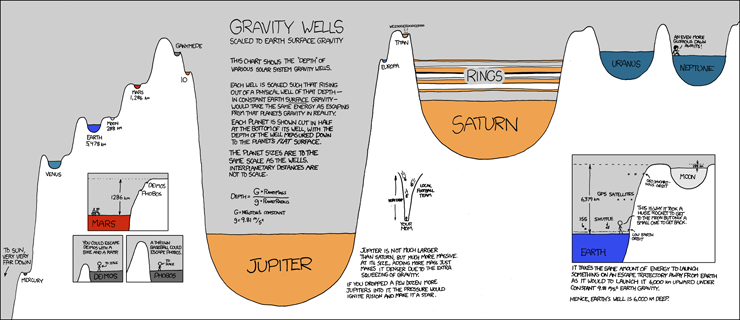
xkcd on intercepting asteroids heading towards Earth
Newspapers have gone pleasingly quiet on the Large Hadron Collider, since the run plan was announced earlier this month. It beat the pessimistic, “if at all” tone of reporting just three days earlier. Given previous loud public statements about scheduling, one could argue that we only have ourselves to blame — but it's pretty hard to take some of the free commentary, such as this piece of farfetching on the connection between the LHC and an abandoned Mayan temple. Really. “And like Xunantunich, the collider these days is silent, if not abandoned,” we are told. Stephen Weinberg's response as quoted in the article, “I don’t see it in quite those apocalyptic terms,” is a marvel of understatement.
Meanwhile, yet another tendentious proposal for peace between science and religion has been launched. It is not noted for its theological insight. “Most scientists and most religious believers refuse to be drafted into the fight,” the writer says. Speaking as a scientist and a Christian, I also refuse to be drafted into this sort of attempt at peacekeeping. One problem with peacekeeping forces is that they can have their own agendas; and they are prone to being tone-deaf.
Finally, a chef writes on making “organic” and other small farms more robust against disease:
Healthy, natural systems abhor uniformity — just as a healthy society does. We need, then, to look to a system of food and agriculture that values and mimics natural diversity. The five-acre monoculture of tomato plants next door might be local, but it’s really no different from the 200-acre one across the country: both have sacrificed the ecological insurance that comes with biodiversity.
What does the resilient farm of the future look like? I saw it the other day. The farmer was growing 30 or so different crops, with several varieties of the same vegetable. Some were heirloom varieties, many weren’t. He showed me where he had pulled out his late blight-infected tomato plants and replaced them with beans and an extra crop of Brussels sprouts for the fall. He won’t make the same profit as he would have from the tomato harvest, but he wasn’t complaining, either...
Sunday, 7 June 2009
Second thoughts
Work trips put one behind on reading, and on blogging. Here are some things I've been looking at in the last six weeks or so, concerning, in some way, re-thinking a received position.
From the New York Times:
Mary Beard, on Roman book trade and culture
Looking back on decisions about prisoner interrogation
When “bad advice” is the best advice
On the off-brand presidency
On a recognition Israel doesn't need
On the decline of Christian communities in the Middle East
Web comics:
xkcd on changing the rules
PhD Comics on research topics guaranteed to be picked up by the news media
Blogs:
Byron Smith on dying with dignity
Scot McKnight on justification and the New Perspective on Paul: 1, 2, 3, 4, 5, 6, 7, 8, 9, 10, 11, 12, 13, 14, 15 and ... [one needs to be patient to do anything more than skim these]
Food for thought:
From an NYT op-ed opposed to the drone-war being fought in Pakistan, a comment with resonance for anyone opposed to extremist behaviour, including myself (let the reader understand):
And from the LRB, Jenny Diski, in a (subscription-required) article on schooling, reflecting on teaching as a young idealist in the early 70s, in an inner-city comprehensive:
From the New York Times:
Mary Beard, on Roman book trade and culture
Looking back on decisions about prisoner interrogation
When “bad advice” is the best advice
On the off-brand presidency
On a recognition Israel doesn't need
On the decline of Christian communities in the Middle East
Web comics:
xkcd on changing the rules
PhD Comics on research topics guaranteed to be picked up by the news media
Blogs:
Byron Smith on dying with dignity
Scot McKnight on justification and the New Perspective on Paul: 1, 2, 3, 4, 5, 6, 7, 8, 9, 10, 11, 12, 13, 14, 15 and ... [one needs to be patient to do anything more than skim these]
Food for thought:
From an NYT op-ed opposed to the drone-war being fought in Pakistan, a comment with resonance for anyone opposed to extremist behaviour, including myself (let the reader understand):
Governments typically make several mistakes when attempting to separate violent extremists from populations in which they hide. First, they often overestimate the degree to which a population harboring an armed actor can influence that actor’s behavior. People don’t tolerate extremists in their midst because they like them, but rather because the extremists intimidate them. Breaking the power of extremists means removing their power to intimidate — something that strikes cannot do...
And from the LRB, Jenny Diski, in a (subscription-required) article on schooling, reflecting on teaching as a young idealist in the early 70s, in an inner-city comprehensive:
The lack of oversight, and of targets, must send a chill of horror through any modern manager of a school, and with some reason: it was pretty haphazard, and who was to say that only good teaching would or did come of the laissez-faire system? The line between liberty and libertarianism is very indistinct, and the desire to dismantle bureaucracy and social inequity leaves open the possibility of chaos, and creates endless opportunities for individual self-aggrandisement. But it seems to me that the risks were worth taking, now that we've seen the dismal results of our 20-year-long experiments with centralised targets, management echelons and paper-based accountability.
Wednesday, 18 February 2009
xkcd on the Neutral Point of View
Randall Munroe comments on Wikipedia's sententious “Neutral point of view” policy in the latest xkcd comic, Neutrality Schmeutrality.
As usual, the mouse-rollover extra is worth the effort.
As usual, the mouse-rollover extra is worth the effort.
Sunday, 18 November 2007
xkcd
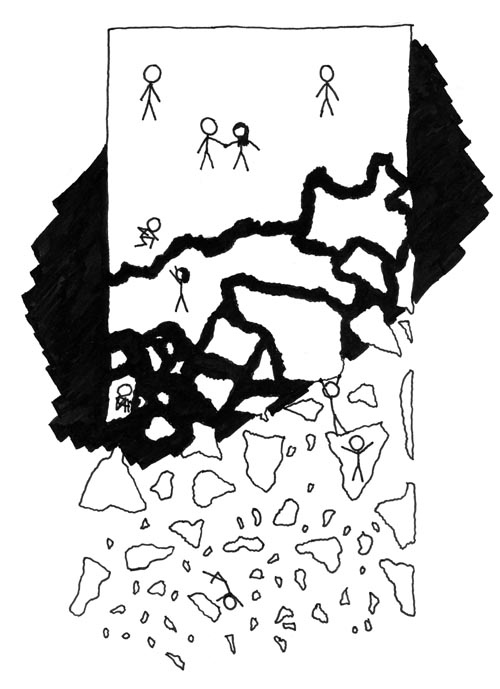
Recently I've been enjoying xkcd, aptly described on its site as "A webcomic of romance, sarcasm, math, and language." This example is "Fall Apart", from 5th May last year.
It's not for everyone, by any means, but if you've ever been a geek, or loved one, you'll find something here to like. Spoiler Alert is one of the more accessible examples of the strip's sense of humour. (Note: it means what it says.)
Subscribe to:
Posts (Atom)